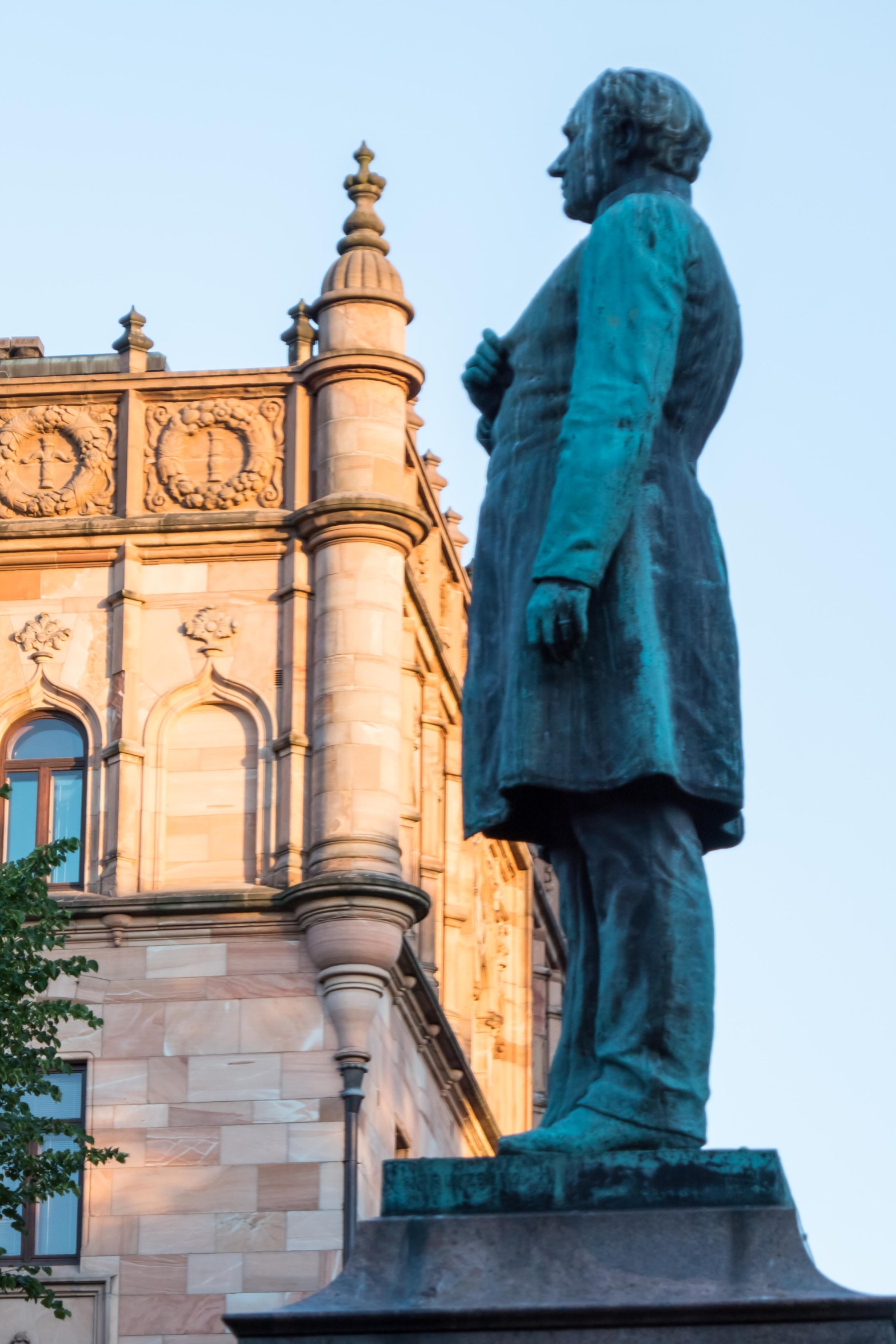
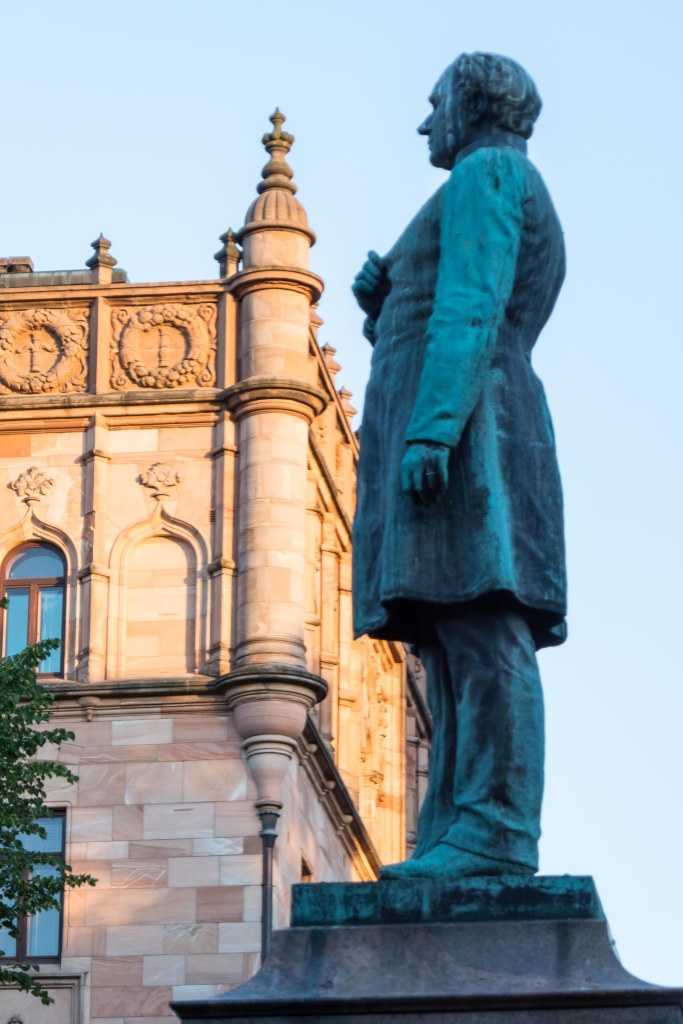
On 13 May 1848, at a student spring party, the Finnish national anthem (Maamme/Vårt land) was performed for the first time. Johan Ludvig Runeberg (him in the picture) had written the lyrics a few years earlier, and they had been set to music several times. These efforts were not particularly successful until the Hannover-born Fredrik Pacius, music teacher at the university, was given the task to compose a new melody specifically for this spring party. The reason was to give an outlet for the students’ patriotic feelings, at the same time carefully avoiding any revolutionary overtones. It was 1848, a revolutionary year in Europe, after all, and la Marsellaise had been heard in the streets of Helsinki. The representatives of the imperial Russian administration were determined to stamp out anything that could undermine the rule of the Czar, and thus the governor-general and the vice-chancellor of the university made sure that Maamme was sung several times throughout the night – so as not to give any opportunities to subversive attempts to sing revolutionary songs. Patriotic feelings were acceptable, but any hint of revolutionary inclinations was out of bounds. The tactic worked as the anthem was owned by the students that day – and by a wider audience when it was performed in a concert three days later. Essentially from the beginning Pacius’s version acquired the status of national anthem.
Later Pacius’s melody was given lyrics in Estonian, and was performed for the first time in Tallinn in 1869. Since 1920 it has also been the national anthem of Estonia.
But what was sung before in Finland? In 1848 it had been part of Russia for 40 years and the Czar and members of the imperial family had visited several times. So, proper expressions of loyalty had been needed. Here, the natural answer was the Russian imperial anthem. Since 1833 Russia had had such anthem of its own – one that survived until the revolution. The melody was the result of a composing competition, and lives on in many guises. It is used in many American institutions – for example, the song Hail, Pennsylvania of the University of Pennsylvania uses the melody, so I got acquainted with it during my student days.
Going further back, already in 1816, after the Napoleonic wars, Czar Alexander I had wanted Russia to have an imperial anthem. He chose the tune of God Save the Queen with Russian lyrics under the title The Prayer of Russians, and this tune was used until 1833. The lyrics had been translated into Finnish under the title Eläköön armias (Long live the gracious) and had been sung in official contexts to the Emperor, members of the imperial family and representatives of the Russian administration since the conquest of 1808-09.
What about when Finland was part of Sweden until 1808? In fact, the country had sung C. M. Bellman’s Gustafs skål (to Gustaf’s health) from 1772 onwards, but in 1805 it also started to use the melody of God Save the Queen with Swedish lyrics under the title Bevare Gud vår kung. The Finnish translation was not very successful, though. In Sweden itself this melody was used until 1844 when the current anthem (Du gamla, du fria) was adopted.
Thus, for 28 years, both under the Swedes and the Russians, the tune of God Save the Queen was sung as national anthem in Finland.
 Rails, wines, worlds