
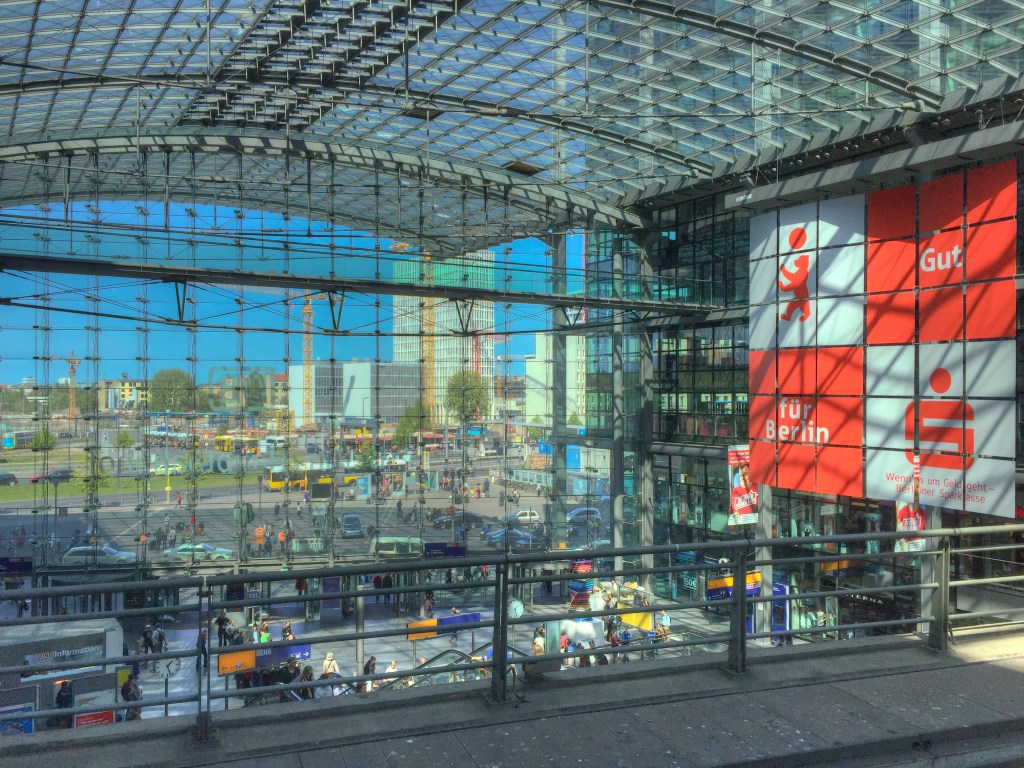
The Berlin Hauptbahnhof is a glimmering modern version of the traditional train shed structure of classical main line stations. However, the difference is that it is a through station of both east-west and north-south connections, reflecting the needs of modern cities and train travel patterns.
Historically Berlin railway stations were termini, like those in London and Paris. Berlin had Anhalter Bahnhof, Potsdamer Bahnhof, Lehrter Bahnhof and so on, stations that got their names from the general direction the trains came from. Most of these were destroyed during the war, and afterwards the division of Germany meant that most trains arriving from outside the city were directed towards stations in the east. Thus during my Interrail years in the 1980s, international trains indicated their destination as Berlin Ostbahnhof or Berlin Lichtenberg. You couldn’t travel in East Germany with an Interrail pass, so these stations weren’t part of my travel plans.
In the absence of rail traffic to the hinterland, West Berlin did not have a need for many railway stations, and so they detonated what was left of the Anhalter Bahnhof and made do with the Berlin Zoologischer Garten as the main stop for international trains in the west of the city. By agreement this station was maintained by the East German railways (Deutsche Reichsbahn, DR), which did not have much of an incentive to do that well, so by the 1980s it was badly lit, dingy and dirty.
Towards the end, the East German regime tried to raise the status of Berlin Ostbahnhof by renaming it Berlin Hauptbahnhof. After the German reunification, it reverted back to Ostbahnhof, as building the new railway structure for the unified city began. The extensive pre-war rail corridors meant that there was enough room to recreate many of the rail connections of the city. And the spot where the old Lehrter Bahnhof had been was chosen for the new Hauptbahnhof. It combined the east-west S-Bahn and main line tracks with a new north-south rail corridor that was built where the Lehrter and Anhalter Bahnhof approach tracks had been (with a tunnel inbetween). Ostbahnhof has also preserved its status as a long-distance station.
It is in the nature of a through station that most trains do have to pass through, and these days the end stations for Berlin-bound long-distance trains are often Berlin Gesundbrunnen in the north or Berlin Südkreuz in the south of the city serving the Hauptbahnhof on their way there. But you can also have a high-speed long-distance train from Stralsund on the Baltic coast to Munich via Berlin, avoiding the need to change trains and stations.
Many of the old termini names live evocatively on. Anhalter Bahnhof, Görlitzer Bahnhof and Lichtenberg S-Bahn stations continue to link Berlin’s past to its future. Even at the Hauptbahnhof S-Bahn platforms a small sign proclaimed “Lehrter Stadtbahnhof” for a few years, but it is now gone.
Through stations are also being built in London for commuter use as the result of the CrossRail 1 and possible Crossrail 2 projects, and in Paris the old RER network is being expanded with the Grand Paris Express to allow more cross-regional links – but so far there are no through long-distance trains. For example, the TGV from Brussels to Côte d’Azur skirts Paris altogether. The old termini are not serving their cities well enough these days.
 Rails, wines, worlds