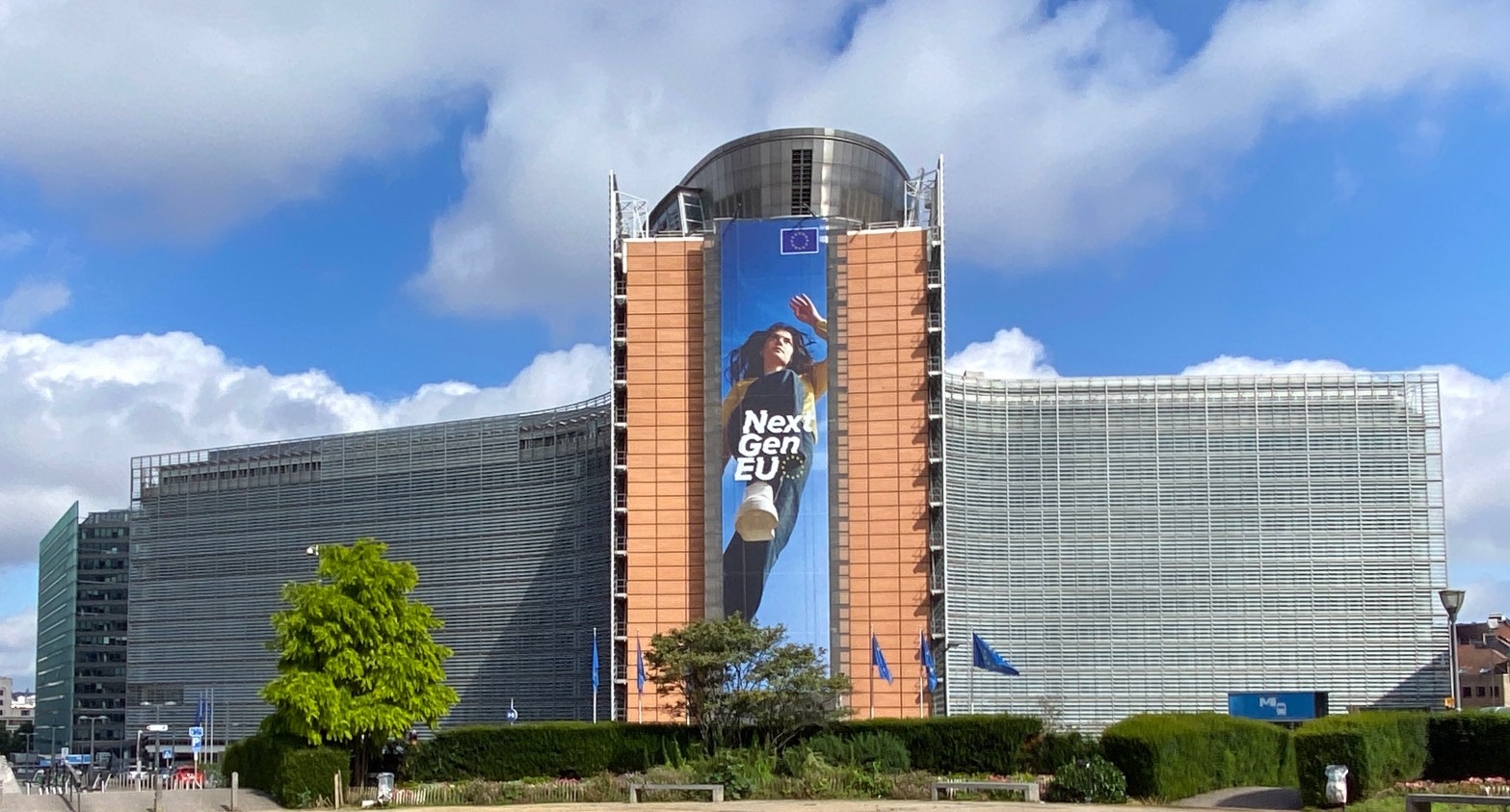
Major buildings in capitals are often named after prominent politicians of yesteryear, or worthy historical figures – there are plenty of those in Brussels. Then there are those buildings that seem to get their names by chance.
The headquarters of the European Commission in Brussels is called the Berlaymont. Many people know that there was some religious institution at the spot where the building now stands, but few know the background of the sisters of Berlaymont.
The original Berlaymont is a small village on the river Sambre in Belgium. Florent de Berlaymont was a political ally of Philip II of Spain in the Spanish Netherlands and a prominent figure in the local political strife. His wife Marguerite de Lalaing (1574-1650) experienced a religious awakening and founded the ‘Dames de Berlaymont’ as an Augustinian order of nuns in 1624. The first location of the convent was close to the cathedral of Sainte-Gudule in the centre of Brussels. It even gave name to a street, which, however, disappeared during the construction of the railway tunnel underneath the city.
The French revolutionary administration closed the convent in 1798, although by this time it was primarily a boarding school. The former nuns and lay teachers were forced to move around in various locations in Brussels, and not even the new Dutch administration after 1815 helped much, as the protestant Dutch were not keen on catholic schools. The Belgian independence in 1830 led to the re-establishment of the convent and boardng school.
After a series of moves necessitated by the growth of Brussels and its new public buildings, in 1864 the convent was given a plot far in the outskirts of the city along the new Rue de la Loi, where they had a set of buildings surrounding a park. This arrangement turned out to be longer-lasting, but a hundred years later property speculators keen on new office space around laid their eyes on this plot and started bidding. However, the Belgian State was also interested and managed to buy the convent lands for the specific purpose of constructing the headquarters of the European Commission on it. Then with the inevitable bureaucratic and construction delays, the new Commission headquarters was built there between 1961 and 1970.
As a side note, barely 20 years later the building had to go through a fundamental renovation to remove the asbestos used in the 1960s. With similar inevitable delays this took almost 15 years, to 2004.
And the convent? The convent and its boarding school moved to Waterloo, just south of Brussels, in 1963, and are still there.
Source: Thierry Demey: Brussels, capital of Europe.
 Rails, wines, worlds