When imperial China wanted to construct the first major domestically-oriented railway line from Peking to Hankow (a city that in 1927 merged with Wuhan on the other side of the Yangtze river), they turned to a Belgian company. Why?
In the turn of the 20th century, as part of its modernisation efforts, China wanted to connect the north and south of the country, Peking (Beijing) and Canton (Guangzhou) via Hankow by rail. Railway construction in China had so far been mostly linked to concessions to the great powers. For example, Russia built lines from Vladivostok to Harbin and Port Arthur (Lushunkou). However, China sought managers for the new project that were not directly linked to the interests of the great powers. For its part, at this time Belgium was one of the leading manufacturers of railway equipment and had the densest railway network in Europe, but had fewer colonial ambitions in China than the great powers.
Combining Belgian and French financial and railway industries would provide enough resources for the project without too colonial overtones. Thus, the contract to build the railway was signed between China (the Imperial Chinese Railways) and a Belgo-French firm formed for this purpose, Societé d’Etude de chemins de fer en Chine, in 1898. The agreed first phase covered the track from Peking to Hankow, 1214 kilometres. The works started in 1899 and the line was completed in 1905. The building works were supervised by a Belgian engineer, Jean Jadot, who later became director and governor of the Société générale in Belgium. It should be noted that the extension of the line from Hankow to Canton was only built between the two wold wars.
The railway was put to good use already before its completion, as in 1902 the dowager empress Cixi returned to Peking after the Boxer revolt by train. She did not travel alone, however, as her ministers, cooks, eunuchs and other servants made an entourage of 1500 people.
The Peking-Hankow line proved to be so profitable that the Chinese imperial railways bought it in 1908. Although a recent high-speed line now connects the cities, the upgraded and slightly straightened original line still serves slower trains.
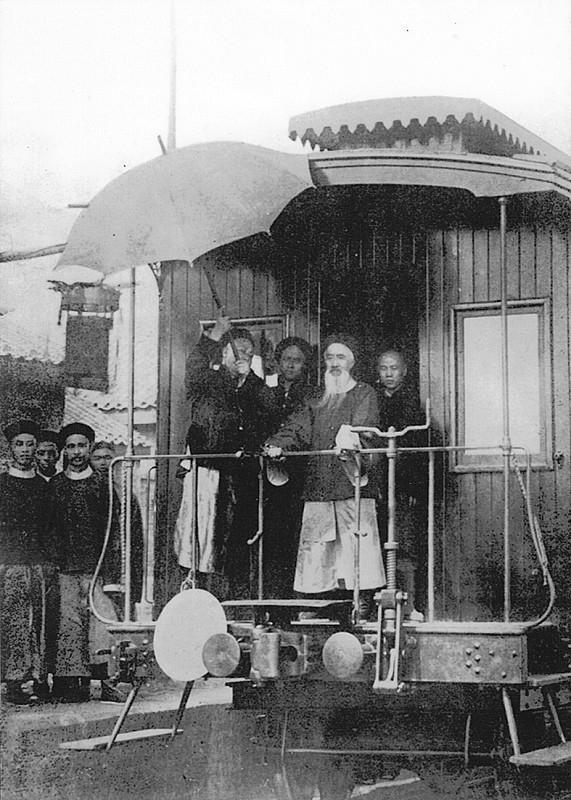
Source: The exhibition ‘From Peking to Hankow – A Belgian adventure in China’ is in the Train World, Brussels, until 10 October 2021. In the picture viceroy Zhang Zhidong, who negotiated the financing for the railway, inaugurates a section of the line.
 Rails, wines, worlds