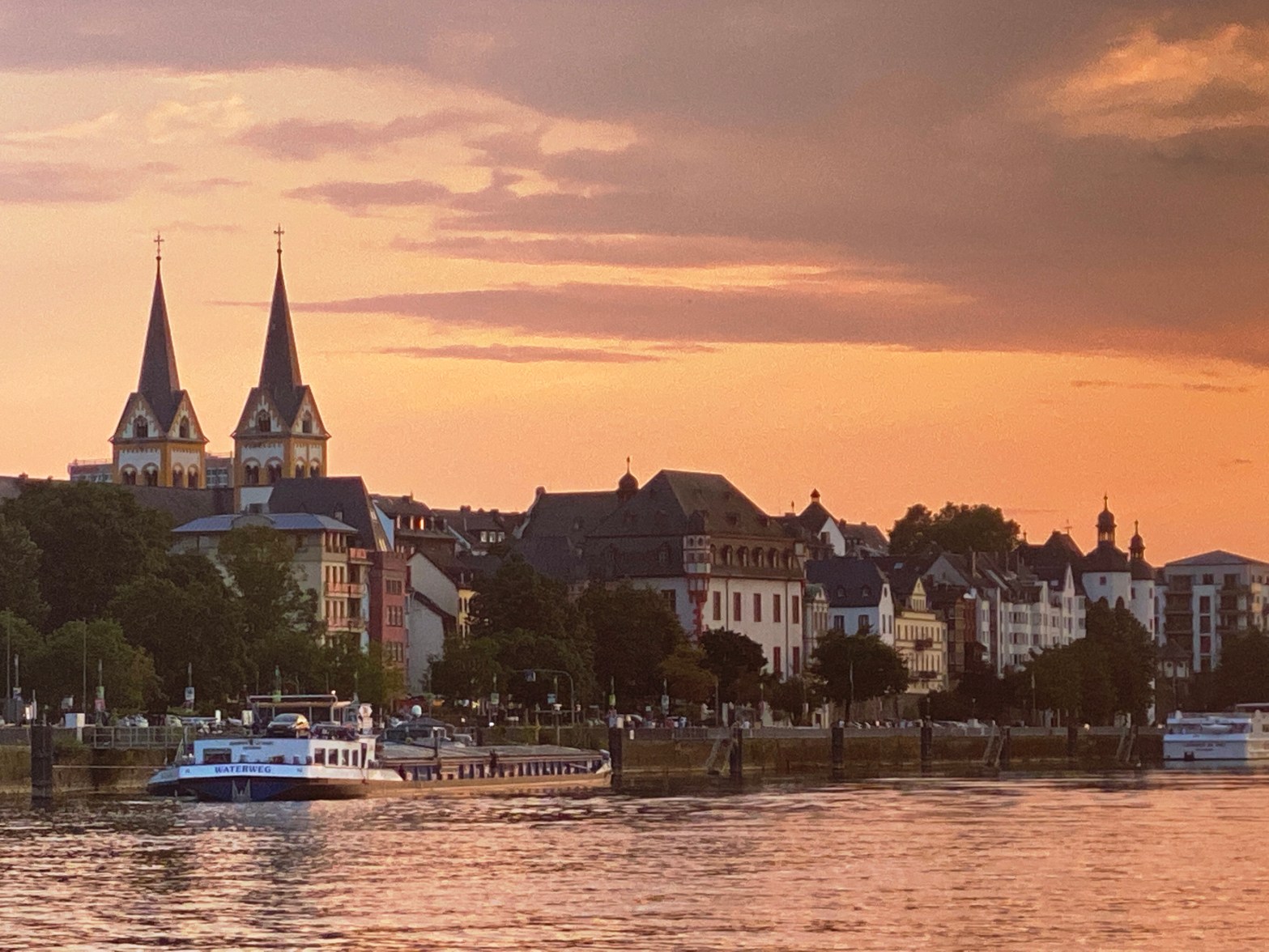
QR codes, tracing forms, masks, distances – travel these days is just an extension of home.
My recent five-day trip to the parts of Germany that are near the border of Belgium (Aachen, Cologne, Koblenz, Trier) gives an indication how the Germans do travel these days – of course, all countries do their own thing, so no generalisations are possible. But in many ways it is a bureaucrat’s wet dream.
Crossing the border from Belgium to Germany with train was as usual, nobody checked anything, you only got the reminder about rules from the Deutsche Bahn as part of your reservation – plus three identical text messages from the German Federal Government urging you to adhere to the rules. The hotels did check your covid-pass at check-in but did not read the QR code – so far nobody has done that anywhere in the month that I have had my pass. Furthermore, trains and buses in Germany required a medical mask (FFP1 or FFP2), nothing else would do. Some buses had signs saying that you should only use FFP2, although the enforcement was very un-German, i.e. lax.
Restaurants and museums did not require covid pass, but for contact tracing purposes they needed your details. Many had a QR code that you can scan with an app called Luca that transfers the information to them. That was quick and convenient, but the more staid places used the old approach of paper forms and pens. The pens were naturally disinfected after each use – they went from one penholder to another in the process. Watching the filled-in forms, I did wonder about the efficacy and speed of processing of the piles of paper – if contact tracing were ever needed, speed would be essential.
As a general observation it occurred to me that everybody seems to have forgotten the covid warning apps – I still have three of them, all supposedly compatible with each other and with the Apple tracing interface. However, this time the German Corona-warn thing was never able to synchronise information with its server. And my two other ones are no longer giving me any alarms about contacts with possible infections.
Other than the additional contact tracing bureaucracy, travel was as good as it ever was – including the usual mishaps. For example, there was the two-day train driver strike, which meant that very few long-distance trains were running. Fortunately my destinations were all reachable with regional trains, many of which managed to run despite the strike.
When travelling towards Trier, I paid particular attention to the banks of the Mosel river to see whether there were any visible signs of the recent floods. Nothing was visible in the lower Mosel area, although the track was still out of use near Trier and there was a replacement bus service.
A detail was that one replacement bus driver did not know where he was going, but followed slavishly the instructions of his navigator – where one intermediate stop was not programmed in. This meant that about three quarters of the passengers in the bus who were trying to catch the train at that particular stop missed their connection and had to wait for the next train. Fortunately the wait was not too long. Although then that train stopped for half an hour at an intermediate station for inexplicable reasons (we were told ‘access to Koblenz is blocked’).
Judging from the languages I heard, the Americans are travelling again, in particular cruising along the Rhein, it seems. Other than that I spotted only the occasional foreigner among the Germans – the lack of crowds made the whole experience more relaxing, although I expect that the travel industry would not agree.
 Rails, wines, worlds