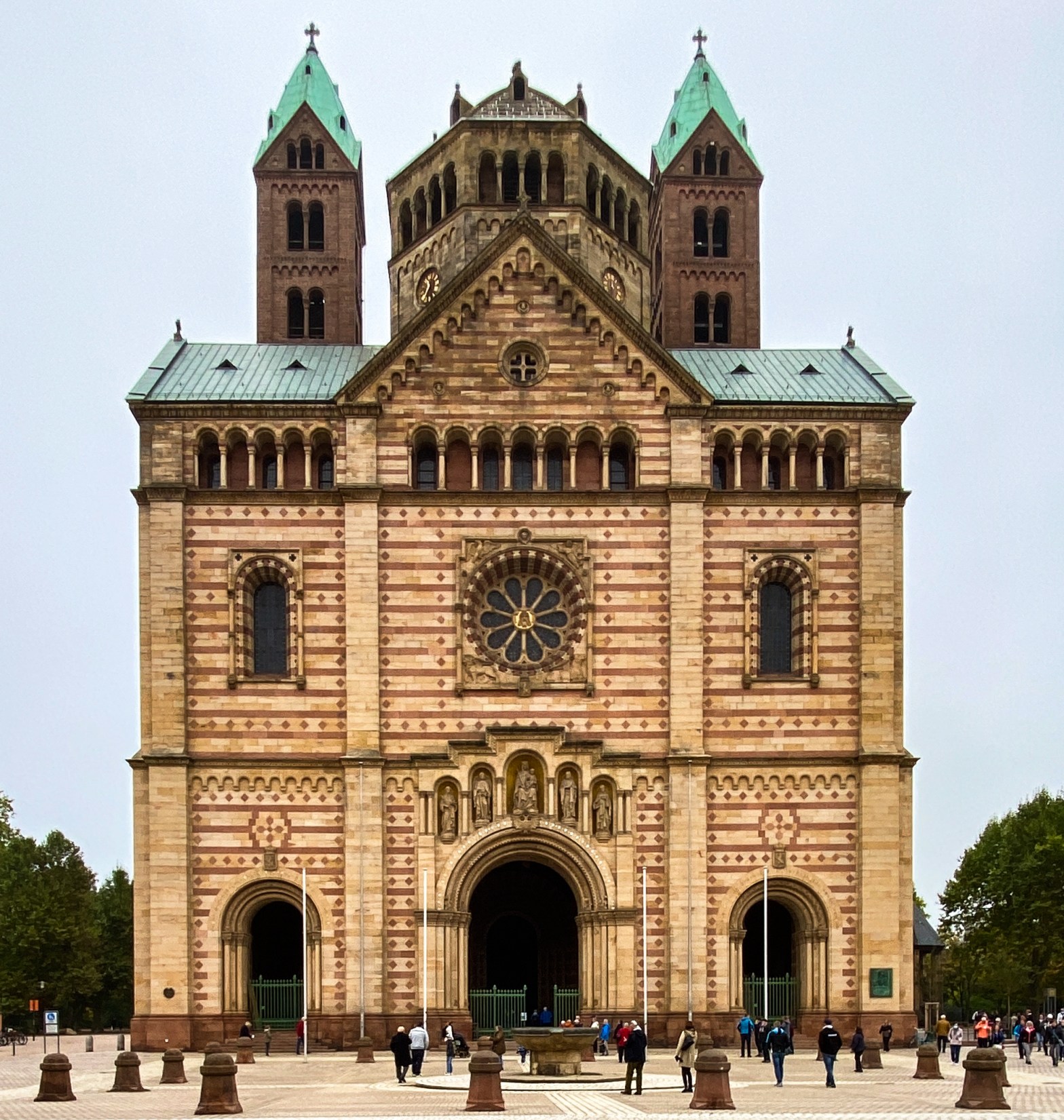
The Cathedral in Speyer (or Domus sanctae Mariae Spirae) was built at the initiative of Conrad II, first emperor of the Salian dynasty. The minor detail of actually getting anywhere took a couple of decades (and emperors), but the cathedral was consecrated in 1061, although further construction and expansion continued until 1106. The cathedral was heavily damaged by the retreating troops of Louis XIV in 1689 and rebuilt only in the second half of the 18th century. The facade was renewed in the mid-19th century in neo-romanesque style. Despite its turbulent history, the cathedral looks today much as it did in 1106.
When finished, the cathedral was the longest church in the Occident at 134 metres – longer than the original old St. Peter in Rome. And after the destruction of Cluny Abbey during the French Revolution, it is the largest romanesque church. For a town of about 500 inhabitants at the time, this would seem to be slightly excessive. However, as often is the case, we are not talking about practicalities, but about a statement, a claim of ecclesiastical power for the emperor against the pope.
But the strife between the Holy Roman Empire and the pope had a long pedigree, and at this point the pope was still in a position to keep the emperor in check. Thus the power grab of the Salians did not end so well, as emperor Henry IV had to make his famous humiliation trip to Canossa to petition the pope to lift his excommunication. He started the trip from Speyer, his favourite town.
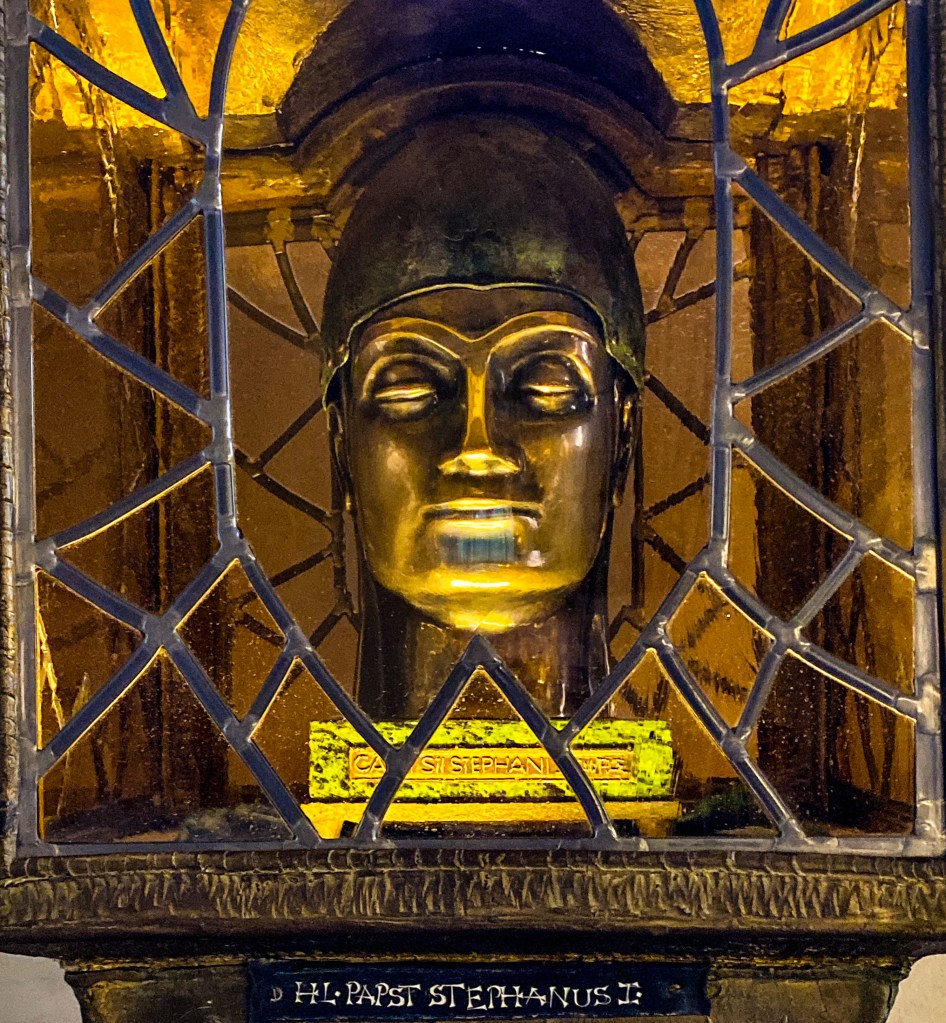
The cathedral became the favourite resting place of all the Salian emperors, from Conrad himself to Henry V, who died in 1125. Assorted later medieval German kings (who were not crowned emperors) have also been buried there, including Rudolf I von Habsburg, who established the eponymous royal and imperial house. The location of the graves was lost over the centuries, and all were excavated and relocated in the crypt in 1900-1906. Besides graves, the cathedral has – as usual – a reliquary with assorted body parts of various saints, including the partial head of pope Stephan I in a fetching bronze vessel (see below).
The cathedral was also a reason for Speyer to become a large Jewish town. With the approval of Henry IV, the Bishop of Speyer issued a privilege that allowed the jews to carry out all trades, of which finance was particularly important for the construction of the cathedral.
But we should not forget the lowly bureaucrats. The itinerant emperors of the Middle Ages needed a place for their archives, and the Salians and many of their successors entrusted the Bishop of Speyer to supervise the imperial chancellery that was located in Speyer until the late fifteenth century.
Sources: Wilson: The Holy Roman Empire; Schappert – Colletto: Der Dom zu Speyer.
 Rails, wines, worlds