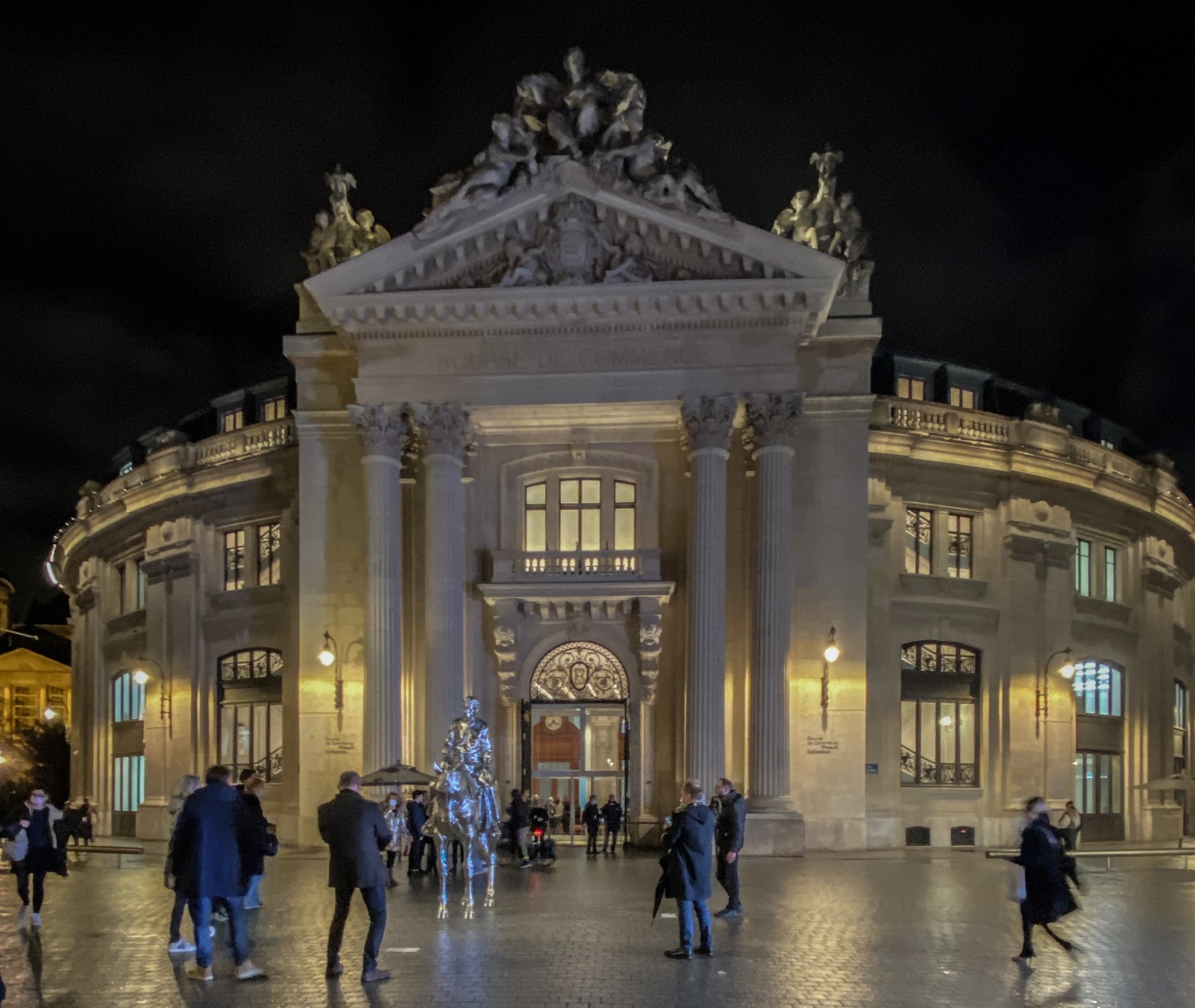
Good buildings can have many lives over the centuries – they can store grain, merchants or art, depending on the needs of the population.
The Bourse de Commerce in central Paris started its life as a grain storage facility. The growth of Paris made the previous facilities too small, but upholding public order required having this staple food available relatively close to the citizens. Thus in 1765 a round building with an open courtyard was created for this purpose.
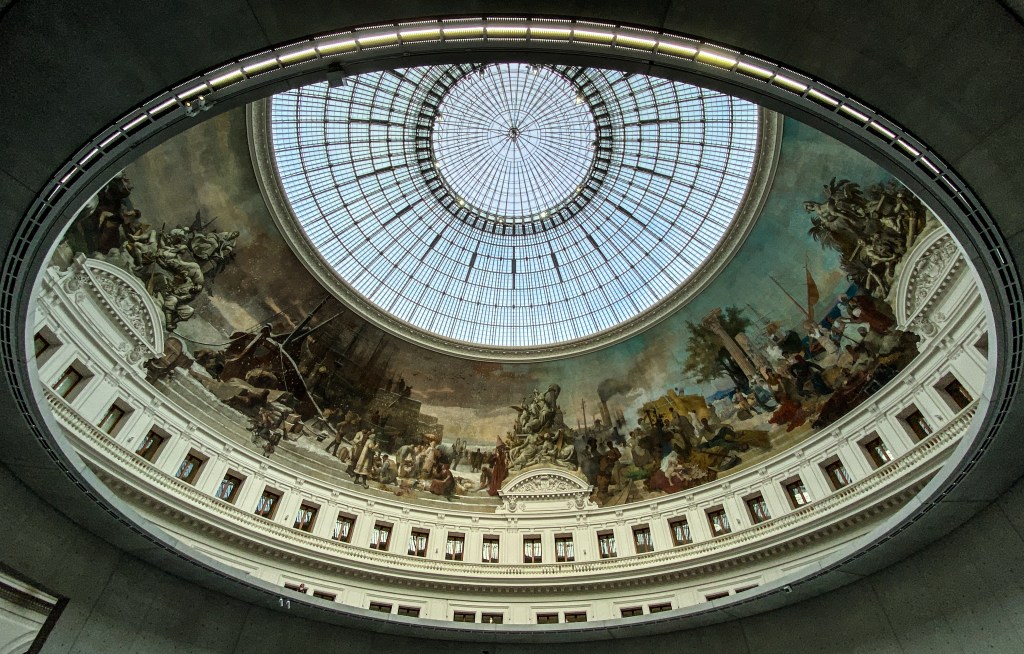
The open courtyard was soon covered temporarily with a wooden roof, but in 1783 a cupola – also in wood – replaced this until it burned down in 1802. A new cupola was then constructed between 1811 and 1813 in cast iron, covered with glass. This cupola still stands above the building.
The advances in transport in the 19th century made grain storage in city centres unnecessary, but the building was used as an intermediate storage facility for wholesale grain merchants until 1873. However, Paris needed a commodities exchange and so, in 1886-89, the building was converted to a ‘Bourse de Commerce’ by keeping the cupola and the internal walls, and expanding the external walls to gain more space. The lower part of the cupola was at this time covered to provide space for internal decorative paintings.
The Bourse de Commerce served as a trading facility for mostly agricultural commodities, both for spot and future trades until 2016 – although again, technological development since the 1970s had made the transactions electronic and thus there was little need for a grandiose and expensive buiding.
The City of Paris bought the building and rented it for 50 years to billionaire François Pinault (of luxury goods fame, including YSL and Gucci) for his collection of contemporary art. He then carried out a thorough renovation ad restauration that preserved all the layers of the building, including the cupola, inner walls and a double-helix staircase from the period between 1765 and 1813. Japanese architect Tadao Ando added an internal concrete structure to facilitate the movement of crowds inside the building.
The building also has a secret – a very visible one but often overlooked. On the right hand side is a 31m tall column. This is in fact a leftover from an earlier building at the site, Hôtel de la Reine (later Hôtel de Soissons), built on the order of Catherine de Médicis in 1572. The Medici column was originally decorated with the initials of C and H, referring to Catharine and Henri II. During the restoration, plenty of graffitis were found in the staircase inside the column, the earliest dating from 1766, and others from 1889 and the Second World War.
Source: La Bourse de Commerce – Collection Pinault. L’objet d’art hors-serie.
 Rails, wines, worlds