Rails: Border architecture

If you happen to look at the map of Barcelona commuter trains, you can see that line R3 continues outside the suburban area to somewhere called La Tor de Querol – Enveig. If you were to take the unassuming train to its final destination, you would have left Barcelona and Spain altogether and ended up on the French side of the border high up on the plateau of Pyrenees, near Andorra.

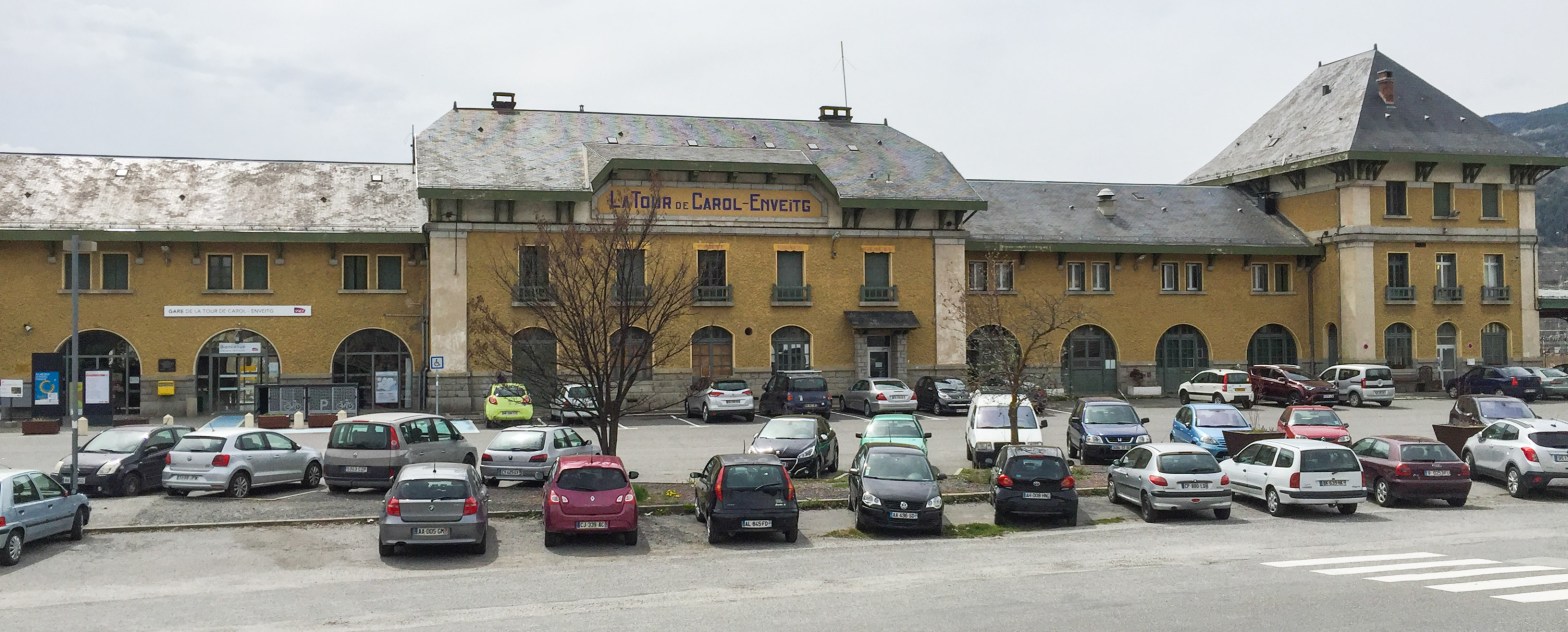
There you would encounter an imposing station building, with the French version of that double-barreled name Latour-de-Carol – Enveitg. This station is a leftover from the time when borders had meaning and when you needed customs controls and change of trains at many borders. Europe has plenty of abandoned large border stations that no longer have any function, where high-speed trains whish past without stopping, and the passengers barely notice the station.

But Latour-de-Carol – Enveitg has avoided this fate. Not because of any local attractions, as the two villages of La Tour de Carol and Enveitg are sleepy, home to only 400 people, and thus do not need a large railway station – if any. However, the historical choices made by the French and Spanish railways mean that trains cannot swish past the station but must discharge their passengers, who – even though border formalities are long gone – need to change trains.

The reason for this is that each of the three train lines leading to Latour-de-Carol – Enveitg has different gauge. The Spanish trains from Barcelona use the Iberian gauge of 1668 mm, the French trains to Toulouse use the standard 1435 mm, and the mountain train to Villefranche-de-Conflent (where it meets again standard gauge track) uses 1000 mm which allows this touristy “Train jaune” to use tight bends on its way up the Pyrenees. Originally the point of this exchange station was to connect Paris to Barcelona via Toulouse, but these days the coastal TGV line takes care of that, and Latour-de-Carol – Enveitg serves mostly local and regional clientele, even though there is a direct Intercités train to Paris.

Thus the tourists that come to see the mountains, or to trek around, can take advantage of the scenic Train jaune, or the more prosaic suburban and regional services, and get to admire the station that is a leftover from a bygone age when borders still had meaning in Europe.

Wine: Where terroir speaks

Can you taste the soil in wines? This is the claim of many a wine producer, but in practice it has been proven that wine roots do not get mineral elements from the underlying rocks. But of course, strictly speaking this is not what we most often refer to when speaking about “mineral” wines. We use it as a shorthand for a group of taste sensations that do not fall into the other categories like “fruit”. These sensations do not have to come directly from the rocks, but in our tasting language this is how we can best describe them.

A recent tasting of wines from Faugères was an opportunity to test whether we can find such elements of minerality in wines from one area that professes to have a relatively uniform soil type.

Faugères in Languedoc has a homogenous type of soil, made of various types of schist that is poor in nutrients and drains well while preserving water underneath. Schist is a rock type that consists of layers of minerals and splits into thin plates. Faugères har different types of schist that have different porousness and hardness. The harder the rock, the poorer the soil. It is said that in Faugères the soil talks, not the grape.

Faugères produces mostly red wine, with some rosé and a little white. The tasting had one white, one rosé and four red Faugères wines. When trying to find common elements in the wines, the tasters pointed out some characteristics that seemed to be more or less in common to all of them.

First, although you had plenty of fruit in the nose of the wines, the taste did not follow – it was much more austere, without any fruity yamminess. We struggled to find a description for the dominant features – perhaps something close to wet stones. All the wines had good acidity and the reds displayed slightly varying levels of round tannins.

Second, there seemed to be a certain final sour note in most of the wines. This was not disturbing, just something that emphasised the austere taste. It points to the general aspect of wines that display “minerality” – they tend to be described as refreshing and zesty.

The topic of terroir and mineralogy is fashionable and even wine professionals disagree what exactly we are talking about (see the Jancis Robinson article in the FT). There is speculation whether concrete vats or clay amphorae can give wines mineral character under fermentation, although this probably would not be filed under any terroir feature. In any case, there is much more to discover under minerality.

More about these topics: Jancis Robinson “Minerality report”, FT 25/1/2020; Rosemary George: “The Wines of Faugères”; and Britt Karlsson – Per Karlsson – Bengt Rydén: Languedoc Roussillon, södra Frankrikes viner.

Wines tasted: Crus Faugères Parfum de Schistes Blanc 2018; Domaine Balliccioni Faugères Tradition Rosé 2017; Domaine de Fenouillet Faugères Extraits des Schistes 2016; Château de la Liquiere Faugères Les Amandiers 2014 ; Domaine Valambelle Faugères Grande Cuvée 2013; Domaine des Pres-Lasses Faugères Castel Viel 2011